Read the full review →“We couldn’t believe the transformation after the garage conversion. EcoStar Remodeling & Construction turned it into a home office and gym.”

We use cookies and measurement tools from Google and Meta to measure our ads and improve this site. By continuing to browse, you agree. You can change this anytime. Privacy Policy
EcoStar Remodeling & Construction is an ADU builder in the Bay Area and a licensed general contractor (CSLB 1034806): we build detached backyard units, garage conversions and junior ADUs in Alameda, Contra Costa, Santa Clara and San Mateo counties, from design and permits to the finished unit. It starts with a free site visit to see what your lot allows. Request a free ADU estimate.
Detached ADU: a separate small house in the backyard with its own entrance, kitchen and bathroom. It gives the most privacy and suits rental or family use, and it needs the most site work: foundation, utility trenches and construction access. Attached ADU: an addition joined to the main house with its own entrance, often the simplest way to use a side yard or the space behind the house.
Garage conversion: an existing garage rebuilt as living space. The structure is already there, so the work centers on the slab, insulation, windows, plumbing and electrical. Junior ADU (JADU): a smaller unit created inside the existing home, such as a converted bedroom with an efficiency kitchen; because it stays within the house, it involves less new construction than a detached unit.
Not sure which one fits? We measure the lot and the existing structures on the first visit and show you which options your property allows. More on each type on our ADU builder and garage conversion pages, or see everything we build on our Bay Area page.
A garage conversion can cost less than a detached ADU, but not always. The City of Oakland’s estimates rank converting garage or basement space cheapest per square foot, yet its range for converting an existing accessory structure, which a detached garage can count as, reaches above a new detached unit. A new detached unit needs its own foundation, utility trenches and framing, and in return you choose its size, layout and place in the yard within your city’s limits.
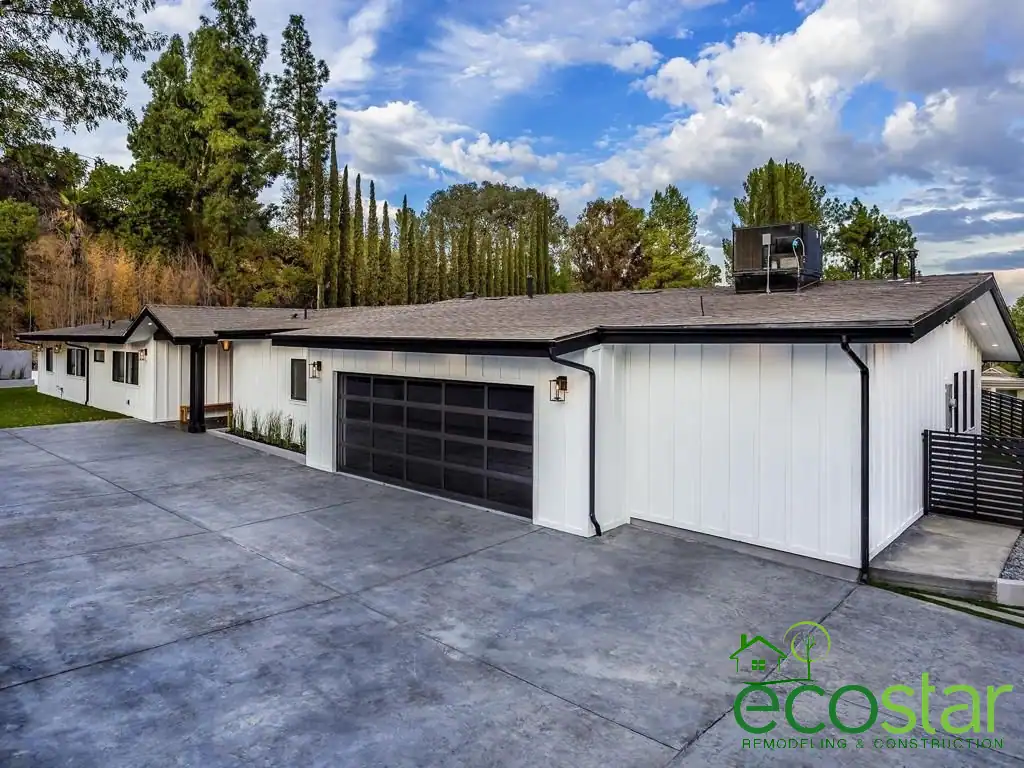
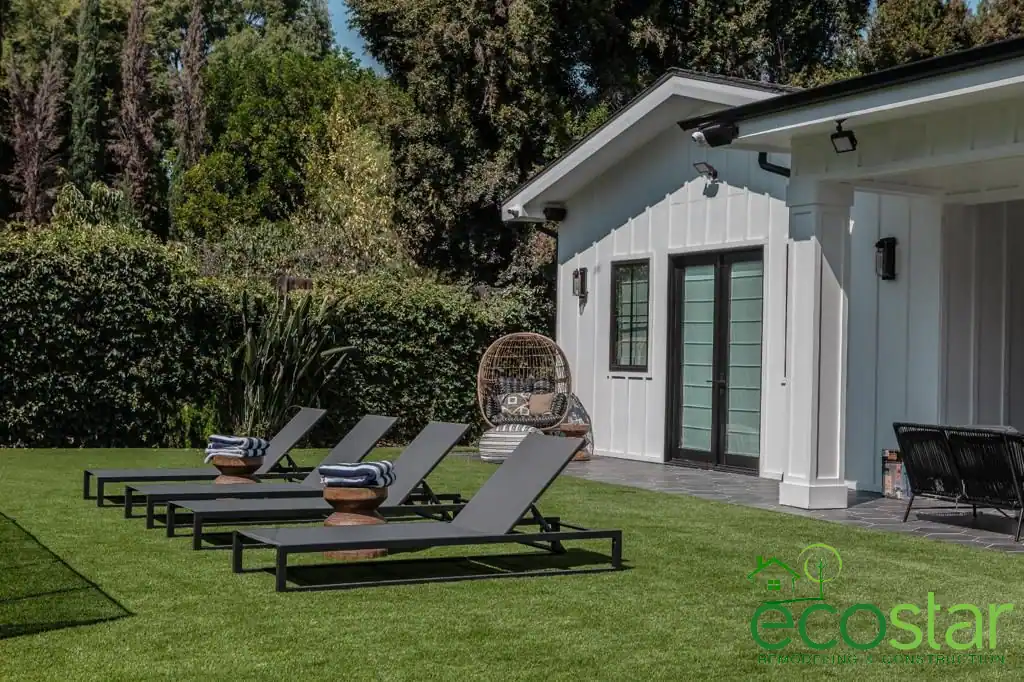
On the first visit we check the garage’s slab, framing and utility routes and show you which of the two your lot allows. Our garage to ADU conversion page covers that path in full, from the slab work to the permit.
Most ADU projects move through the same four stages, and at each one you know what happens next.
We look at lot size, setbacks, trees, slope, the route for utility lines and access for construction, and we talk through how you plan to use the unit: rental, family, home office or guest space.
We draw the floor plan, structure and energy details the permit needs. This is where size, layout, number of bedrooms and finish level are settled, and those choices drive most of the cost.
We submit the plans to your city and handle the plan-check comments.
Cities review ADUs under the state ADU and junior ADU law published by California HCD, together with their own local standards for design, setbacks and utilities.
Some projects also need utility work, such as a new sewer connection or a larger electrical service, which we coordinate with the utility and the city.
Our crews build from the foundation up, or rebuild the garage from the inside, with city inspections at each stage.
After the final inspection we walk the finished unit with you before handover.

Read the full review →“We couldn’t believe the transformation after the garage conversion. EcoStar Remodeling & Construction turned it into a home office and gym.”
Read the full review →“Our ADU build with EcoStar Remodeling went smoothly from start to finish. Foster kept us informed, answered every question, and made sure the space was exactly what we wanted.”
Read the full review →“We needed extra space for my in laws, so we decided to turn our old garage into an ADU and EcoStar Remodeling was the only company that made us feel at ease from the very first meeting.”
Read the full review →“After months of research, we decided to go with EcoStar Remodeling and we’re so glad we did.”
Read the full review →“We recently completed a project with Eco star Remodeling and wanted to share our experience.”
We do not quote a flat price before seeing the site, because these factors move the number most:
After the site visit you get a written scope with the price and a schedule for your specific project.
Alameda: plans go to the Permit Center at City Hall, 2263 Santa Clara Avenue, Room 190, and the City preapproves detached ADU plans from qualified designers; building from one brings a faster review and a reduced application fee, with site-specific plans and engineering still required. Berkeley: the Permit Service Center is at 1947 Center Street, 3rd Floor. Oakland: applications go through the One-Stop Permit Center at 250 Frank H. Ogawa Plaza, online at any hour or in person by appointment or during walk-in hours. San Jose: permits run through City Hall at 200 E. Santa Clara Street.
State ADU and junior ADU law sits in the California Government Code (its sections were renumbered by SB 477 in 2024), and HCD’s ADU Handbook explains how cities must apply it. Within those limits each city sets its own standards for height, setbacks, parking and design, so we read your city’s current rules for your address before drawing anything.
Across Alameda, Contra Costa, Santa Clara and San Mateo counties the process is the same: we prepare the plans, file them, answer plan-check comments and schedule every inspection through to final.
Under California law, your city or county has 15 business days from receiving your ADU application to tell you in writing whether it is complete, and 60 days from receiving a complete application to approve or deny it when a home already stands on the lot, unless you ask for a delay or file the ADU together with a new house (Gov. Code 66317).
On size, the city’s lot coverage, floor area, open space, front setback and lot size rules must still leave room for an ADU of 800 square feet with 4-foot side and rear setbacks that meets its other standards (Gov. Code 66321).
Design, drawings and any items the city lists as missing all come before the 60 days start. If you ask for a delay, the clock pauses for that time, and an ADU filed with a new house can wait for the decision on the house. If the agency misses the first deadline, the application counts as complete; if it misses the second, the ADU counts as approved.
| Rule | What state law says | Gov. Code |
|---|---|---|
| Completeness check | Written notice within 15 business days of receiving the application, with a list of anything missing and how to fix it. No notice in time: the application counts as complete. | 66317(a)(2) |
| Decision | Approve or deny within 60 days of receiving a complete application when a home already stands on the lot. No decision in time: approved. The 60 days pause during a delay you request; with a new house filed at the same time, the ADU can wait for the house decision. | 66317(a)(3) |
| Denial | Within the same 60 days, a full set of written comments on what is deficient and how to remedy it. You can appeal an incomplete finding or a denial in writing, and the agency owes a final written decision within 60 business days of receiving the appeal. | 66317(b), (d) |
| Size the city must allow | Room for an ADU of 800 square feet of interior livable space with 4-foot side and rear setbacks: local lot coverage, floor area ratio, open space, front setback and minimum lot size rules cannot prevent it, as long as the unit meets the other local standards. Larger units follow the maximum-size row. | 66321(b)(3) |
| Maximum size | The city may set a maximum, but not below 850 square feet, or 1,000 square feet for a unit with more than one bedroom. A local ADU ordinance caps a detached unit at 1,200 square feet and an attached unit at 50 percent of the existing home’s floor area, and that percentage cannot block an 800-square-foot unit. | 66321(b)(2), (b)(3); 66314(d)(4), (d)(5) |
| Setbacks | New construction: no more than 4 feet from the side and rear lot lines. An existing structure converted to an ADU, or a new one built in the same place to the same dimensions: no setback. | 66314(d)(7) |
| Height | Detached: at least 16 feet; 18 feet within half a mile walking distance of a major transit stop or high-quality transit corridor, plus 2 feet for a roof pitch that matches the house; 18 feet on a lot with a multistory multifamily building. Attached: 25 feet or the zone’s height limit for the house, whichever is lower; the city need not allow more than two stories. | 66321(b)(4) |
These are the sections as amended from 1 January 2026 (SB 543 for 66317 and 66321). In unincorporated Alameda County (Ashland, Castro Valley, Cherryland, Fairview, Hayward Acres, San Lorenzo, Sunol and the rural east county outside Livermore, Dublin and Pleasanton), the County’s Community Development Agency Planning Department regulates land use instead of a city.
No law sets how long construction takes: that depends on the type of unit, the foundation and utility work and the inspections, so we give you a schedule for your project after the site visit.
Choose a contractor whose California license is active and in the B (General Building) class, the license CSLB names for building an ADU and running the several trades it takes, and sign a written home improvement contract before you pay. The down payment may not exceed $1,000 or 10 percent of the price, whichever is less, and later payments may not run ahead of the work done or materials delivered (Business and Professions Code 7159.5), unless the contractor furnishes a bond or joint control approved by CSLB’s registrar that covers full performance and payment.
Items 5 and 6 do not apply when the contractor furnishes a bond or joint control approved by CSLB’s registrar that covers full performance and payment of the job.
EcoStar Remodeling & Construction holds CSLB license 1034806 in the B (General Building) class, with workers’ compensation insurance on its CSLB record. After the site visit you receive a written scope with the price and a schedule, and our Bay Area offices in Alameda, Concord, San Jose and San Mateo work across Alameda, Contra Costa, Santa Clara and San Mateo counties.
Yes, we do. We are happy to give you a free quote for your project. You can expect a response within 48 hours!
Detached backyard ADUs, attached ADUs, garage conversions and junior ADUs inside the existing house, in Alameda, Contra Costa, Santa Clara and San Mateo counties.
Often, yes. A garage conversion reuses the existing structure, so the work focuses on the floor, insulation, windows, plumbing and electrical. We check the slab, framing and utility routes on the first visit.
It depends on the type of unit, the city’s plan review and the site work: a unit built inside the house or an existing garage needs no new foundation, while a detached unit does. After the site visit we give you a schedule for your project rather than a general estimate.
It depends on the type and size of the unit, the foundation and utility work, the number of kitchens and bathrooms and the finishes. We give you a written price after the site visit, based on your property and your plans.
Under Gov. Code 66317 the city or county has 15 business days from receiving your application to tell you whether it is complete, and 60 days from receiving a complete application to approve or deny it when a home already stands on the lot. If it misses the first deadline the application counts as complete, and if it misses the second the ADU counts as approved. The 60 days pause during a delay you ask for, and an ADU filed with a new house can wait for the house decision.