
Countertops take the biggest bite out of most kitchen remodel budgets, and two materials own the conversation. Quartz vs granite countertops comes up in nearly every design meeting. But the real difference between the two? Not about which slab looks better. It’s about how you cook, how much maintenance you’ll put up with, and what the rest of your kitchen demands from the surface sitting on your cabinets.
Key Takeaways
☑️ Quartz is engineered, non-porous, and never needs sealing; granite is natural stone that you’ll reseal every 1-3 years
☑️ Heat from a hot pan? Granite handles it. Stains from wine or turmeric? Quartz shrugs them off
☑️ Installed cost for both falls in the $50-150 per square foot range, though granite swings wider depending on slab rarity
☑️ In most markets, stone countertops recover 60-80% of their cost at resale
☑️ Neither material qualifies as an outright “green” pick, so the environmental trade-offs are worth understanding before you commit
What You’re Comparing
Granite is 100% natural stone. Quarried from the earth, cut into slabs, polished, and installed. Every piece carries its own pattern of veining, mineral flecks, and color variation. No two granite countertops look the same, which is either the whole point or a headache depending on how much design control you need.
The granite vs quartz countertops split starts at composition. Quartz countertops are engineered. Manufacturers crush natural quartz crystals (about 90-95% of the slab) and bind them with polymer resins and pigments. What comes out is a dense, non-porous slab with consistent color and pattern across every piece. Liked a quartz sample in the showroom? The installed slab will match it closely. With granite, what you see in the stone yard isn’t always what ends up in your kitchen. That unpredictability is part of what makes choosing quartz granite a personal call rather than a spec sheet comparison.
| Property | Granite | Quartz |
|---|---|---|
| Composition | 100% natural stone | 90–95% crushed quartz + polymer resin |
| Porosity | Porous (requires sealing) | Non-porous |
| Heat resistance | High (hot pans safe) | Moderate (use trivets above 300°F) |
| Stain resistance | Moderate (depends on sealant) | High |
| Maintenance | Reseal every 1–3 years | Soap and water |
| Pattern | Unique per slab | Consistent across slabs |
| UV resistance | High | Low (can yellow in direct sun) |
| Food safety | No certification | NSF/ANSI 51 certified |
Where Granite Still Wins
Set a hot skillet straight from the stove onto a granite counter. Nothing happens. Try that on quartz, and you risk a scorch mark or a cracked resin bond. If you cook hard and move fast, granite’s heat tolerance gives it a real, practical edge.
Beyond heat resistance, granite’s biggest draw is looking like nothing else on earth. Each slab forms over millions of years underground, and the color depth and mineral movement are impossible to replicate exactly. That’s why granite still dominates high-end traditional and transitional kitchens. In 2026, honed and leather-finish granite is making a quiet comeback, replacing the polished mirror look that peaked a decade ago. These softer finishes hide fingerprints, cut glare, and add a muted, tactile quality that photographs well and lives even better.
On the processing side, granite is far simpler. No polymer resins, no pigments, no factory curing step. The slab goes from quarry to fabrication shop to your kitchen with minimal transformation. If you prefer materials closer to their raw state, that counts for something.
Where Quartz Pulls Ahead
Spill a glass of red wine on quartz countertops and walk away for the night. Wipe it up in the morning. No stain. No damage. That’s what non-porous means in real life, and it’s the single biggest reason quartz now leads 78% of design professionals’ preference lists according to the National Kitchen and Bath Association.
Granite can’t make that promise. Because it’s porous, liquids seep into micro-cracks whenever the sealant wears thin. Coffee, red wine, turmeric, olive oil. All capable of leaving permanent marks on unsealed granite. And resealing isn’t a one-time job. Most fabricators recommend it annually for heavy-use kitchens, or up to every three years if the counter gets lighter traffic.
Quartz also carries NSF/ANSI 51 certification as a food-safe surface. Bacteria, mold, and mildew can’t penetrate the non-porous finish, making it measurably more hygienic for families who prep food directly on the counter. The design consistency helps too. Coordinating countertops with cabinetry, flooring, and a backsplash across a big kitchen? Knowing exactly what your slab will look like before it shows up makes every other decision easier.
Trend-wise, 2026 has moved away from stark white quartz toward warmer palettes. Soft beiges, taupes, and creamy whites with subtle veining feel less sterile and more livable than the pure whites that dominated five years ago. If you’re already working through decisions for a kitchen remodel for growing families in Los Angeles, countertop selection is usually the anchor choice that shapes everything else.
Cost for a Typical Kitchen Remodel
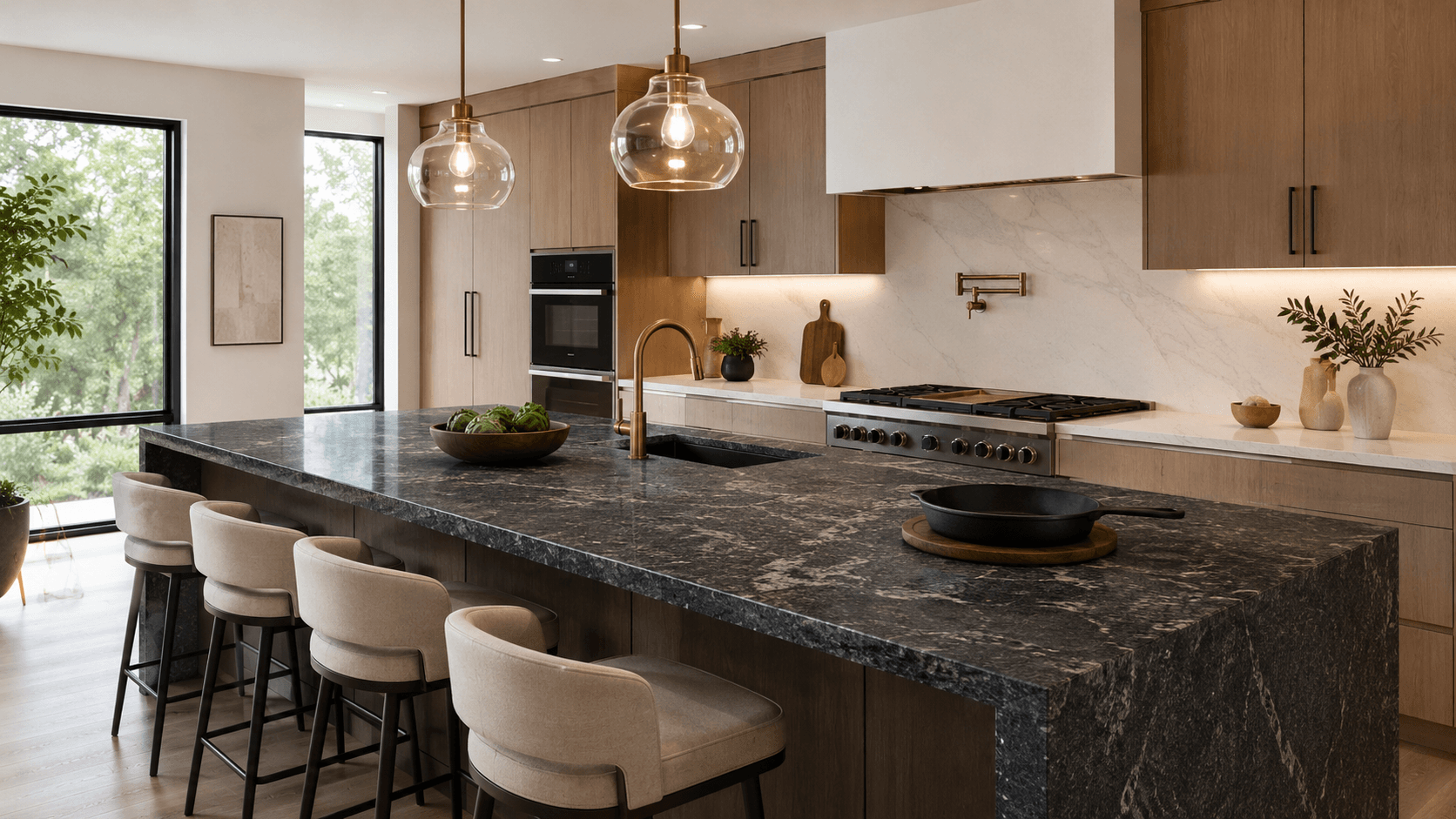
Sticker price is where most homeowners expect a clear winner. There isn’t one. Both materials land in the same ballpark for a typical 30-40 square foot kitchen, and the final number depends more on edge profile, slab selection, and cutout complexity than on which stone you pick. Where the gap opens up is maintenance.
| Factor | Granite | Quartz |
|---|---|---|
| Material per sqft | $40–100 | $50–120 |
| Fabrication + installation | $10–50/sqft | $10–40/sqft |
| Annual sealing cost | $200–400 | $0 |
| 10-year maintenance total | $1,000–4,000 | Near zero |
| Resale ROI | 60–80% | 60–80% |
Price ranges run wider for granite because it’s a natural product. A common Uba Tuba or Santa Cecilia slab costs a fraction of a rare Blue Bahia imported from Brazil. Quartz pricing? More predictable, since every piece comes off a factory line. For most families across Los Angeles, , the Bay Area, or , the all-in countertop spend for either material lands between $3,000 and $7,500 depending on kitchen size and edge details.
When comparing quartz countertops vs granite on long-term cost, granite’s ongoing sealing adds $1,000-4,000 over a decade. Quartz? A bottle of dish soap. That maintenance math matters if you plan to stay in the home 10+ years.
The Environmental Trade-Off
Neither material is an obvious “green” choice, and anyone telling you otherwise is oversimplifying. The countertops environmental picture is more mixed than most product pages admit.
Quarrying is where granite carries its heaviest environmental cost. It disrupts land, generates dust, and burns fuel for transport. A stone quarried in Brazil or India and shipped to a fabrication shop in California has logged serious miles before it reaches your kitchen. But granite undergoes minimal chemical processing. It’s stone, cut and polished. No added binders, no synthetic components.
Quartz manufacturing reduces quarrying impact because it uses crushed stone waste that might otherwise sit in a pile. Some brands incorporate recycled glass and post-consumer content. But the 5-10% resin binding the slab is petroleum-based, and the curing process eats significant energy. There’s also a health dimension that gained attention in 2024 and 2025. Cutting engineered quartz generates fine silica dust linked to silicosis, a serious and irreversible lung condition. Responsible fabricators use wet-cutting equipment and dust-mitigation systems. Shops that skip those protocols? They put workers at risk.
EcoStar sources from fabricators who follow strict dust-control and wet-cutting standards, and our approach to kitchen remodeling includes vetting every supplier in the chain. If you’re weighing the environmental angle, locally fabricated granite with shorter transport routes and quartz from manufacturers with verified safety protocols both represent responsible picks.
How Countertop Choice Fits a Full Kitchen Remodel
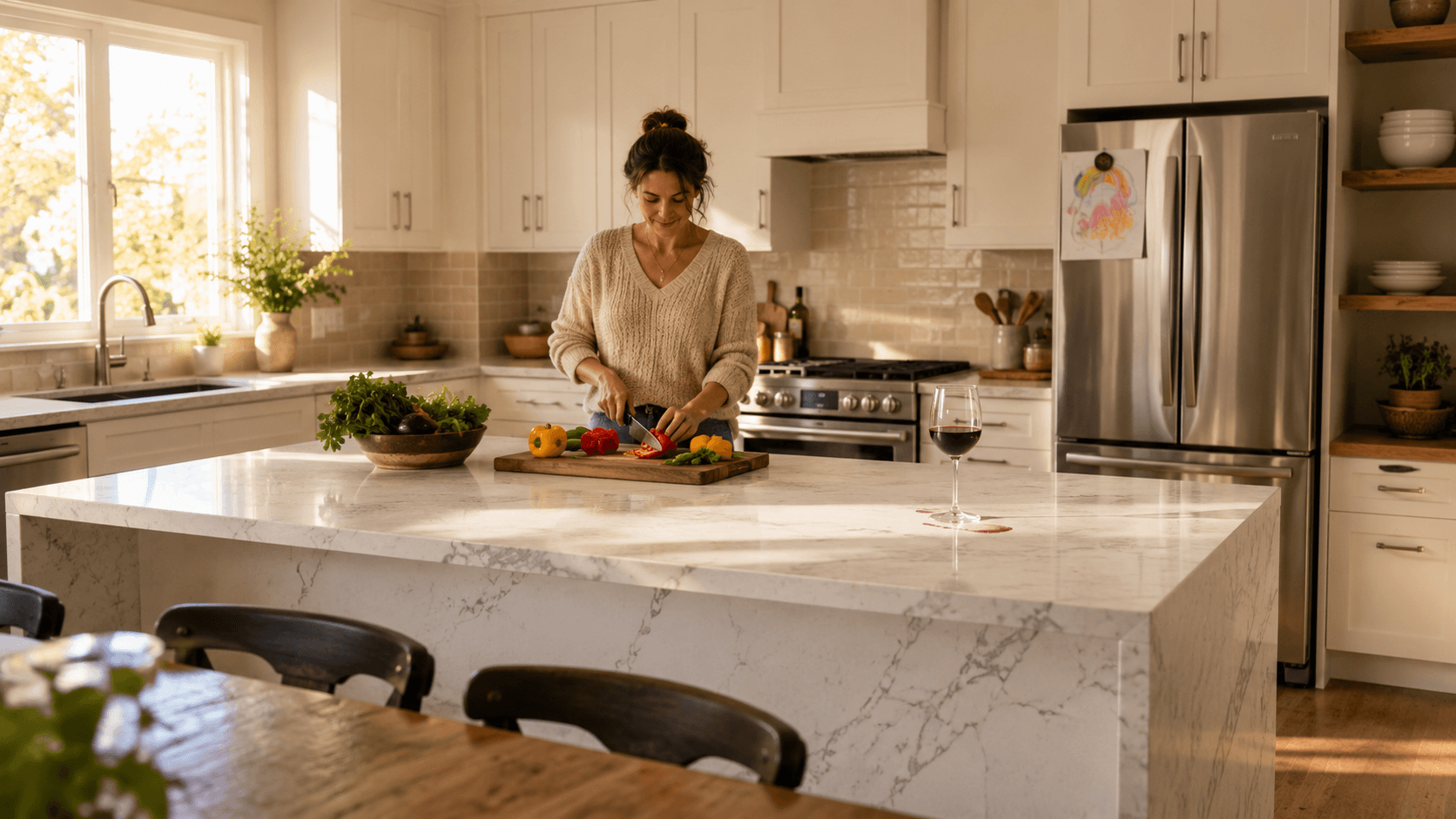
Countertop fabricators talk about the slab. Contractors think about everything the stone sits on, connects to, and affects. That gap in perspective? It matters more than most people realize.
Cabinet Load and Sink Cutouts
At standard 3cm thickness, both granite and quartz weigh roughly 18-20 pounds per square foot. Your cabinet bases need to handle that load, especially around sink cutouts and cooktop openings where the counter is weakest. Undermount sinks install more cleanly under quartz because the engineered material holds a precise edge. Granite works for undermounts too, but the fabricator needs to pay closer attention to where the cutout falls relative to the stone’s natural grain and fissures.
Pick Your Countertop Before Your Backsplash
Too many homeowners get this backward. They fall in love with a backsplash tile first and then struggle to find a counter that pairs with it. Start with the largest surface, then match everything else to it. Fabrication typically takes one to three weeks after templating, so build that lead time into your project calendar.
Fabrication Timing and Project Coordination
EcoStar assigns a dedicated project manager to every kitchen remodel, and the PM coordinates directly with the countertop fabricator so templating, delivery, and plumbing rough-in all line up. That scheduling coordination, backed by a 2-year workmanship warranty, separates a smooth install week from a kitchen that sits bare for an extra two weeks because somebody dropped the ball.
The best quartz vs granite countertops decision isn’t about which material is “better.” It’s about which one fits how you cook, how much upkeep you’ll tolerate, and what the rest of the kitchen needs from it. Ask any contractor who installs both every month. The slab matters less than the quality of the work behind it.
FAQ
Can I put hot pans directly on quartz countertops?
Not recommended. Quartz resins can scorch or crack at temperatures above 300°F. Always use a trivet or hot pad. Granite handles direct heat much better, though thermal shock (moving a pan from a freezing-cold surface to a hot stone) can still cause hairline cracks in either material.
How often does granite need to be sealed?
Every one to three years for kitchen countertops that see daily use. A quick water drop test tells you when it’s time. Place a few drops on the surface and wait five minutes. If the water beads up, the seal is holding. If it soaks in and darkens the stone, reseal. The process takes about 30 minutes and runs $200-400 professionally, or $15-30 for a DIY sealant kit.
Which countertop has better resale value?
Both recover 60-80% of their cost at resale, and both signal a premium kitchen to buyers. In EcoStar’s markets (LA, , Bay Area, ), buyers in the mid-to-upper price range expect stone countertops as standard. The specific material matters less than how well it’s installed and how the kitchen looks as a whole.
Does quartz yellow or discolor over time?
It can under prolonged direct UV exposure. Kitchens with large south-facing windows that flood the countertop with sunlight for hours each day carry the highest risk. If your layout puts the counter in a sun-drenched zone, ask about UV-resistant quartz lines or consider granite for that section.
Can I install quartz or granite countertops myself?
Technically possible but rarely smart. A full kitchen counter set runs 500-700 pounds total across all pieces and requires precision templating, professional-grade cutting tools, and careful seam work. One bad cut can crack a $5,000 slab in seconds. This is one job where hiring a licensed contractor pays for itself on day one.