
Of all the choices you’ll make during a bathroom remodel, tile has the longest shelf life. Pick the right shower tile ideas and you’re looking at a finish that still turns heads in 2035. Pick wrong, and you’ll notice the regret every morning before coffee. Bigger formats, bolder colors, and textures you can feel under bare feet define where 2026 is headed. Here’s what’s worth knowing before you commit.
Key Takeaways
☑️Large-format porcelain cuts grout lines to a minimum and mimics marble, minus the constant sealing
☑️One bold accent wall (think navy, forest green, or matte black) adds drama to even a small bathroom
☑️Floor-to-ceiling tile coverage gives walk-in showers a clean, borderless look that opens up the space
☑️On shower floors, slip resistance beats style every time; penny rounds and small mosaics grip better than large tiles
☑️Two tile formats in one shower (large walls + mosaic accents) build visual depth that still feels cohesive
Large-Format Panels Are Running the Show
Forget color. Forget pattern. The biggest shift in bathroom shower tile ideas this year comes down to size. Porcelain panels in 12×24, 24×48, and full-slab formats have taken over contractor showrooms and Pinterest boards. Why? Fewer grout lines mean less mildew, less scrubbing, and a look that reads as one unbroken plane rather than a grid.
Right now, marble-look porcelain dominates request lists. Homeowners get the veining and depth of Calacatta or Carrara at far less cost. Real marble runs $15-40 per square foot depending on grade. A porcelain tile that nails the same look costs $3-8 per square foot, and you never touch a sealant bottle. Concrete-look panels run a close second, especially in modern and industrial-style bathrooms where a raw, minimal vibe fits the rest of the house.
Most tile retailers skip this part, though. Large-format panels work best with a linear drain, not a center drain. Big tiles can’t slope in four directions toward a single point without cracking or pooling water. They also require an uncoupling membrane (Schluter DITRA is the industry standard) underneath to absorb minor substrate movement. Skip either step, and you’ll spot hairline cracks within the first year. If your contractor doesn’t bring up waterproofing specifics before installation day, treat that as a red flag.
Bold Color on a Single Wall Changes Everything
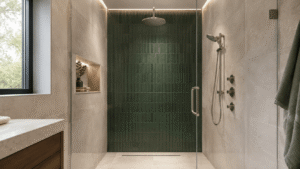
Dark tile across every wall of a shower? Feels like a cave. But a single accent wall in deep navy, emerald green, or matte black? Completely different story. That one wall becomes the focal point, and the surrounding pale tiles keep the space open. For walk in shower tile ideas with a glass enclosure, this contrast works especially well because light still passes through from the bathroom beyond.
Position your accent wall behind the showerhead or along the back of a walk-in enclosure. Pair it with neutral tiles on the remaining walls, and the contrast pulls your eye inward while the room still feels light. Matte finishes hide water spots better than gloss, which matters a lot if you live in a hard-water area like Los Angeles or . In and the Bay Area, the bigger concern is humidity pushing mold into grout joints, so epoxy grout and proper bathroom ventilation matter more than matte versus gloss.
Lighting makes or breaks dark tile. A recessed LED strip along the ceiling or a backlit niche prevents that heavy, boxed-in look. If you’re already exploring bathroom remodeling solutions for a more modern home, an accent wall adds outsized visual impact for a fraction of the total project cost.
What Holds Up on a Walk-In Shower Floor
Walls get all the design attention. But the floor? That’s where bad shower floor tile ideas cause real trouble. Large-format tile looks gorgeous on vertical planes. On a shower floor, it becomes a liability because the floor needs to slope toward the drain, and oversized tiles can’t follow that grade the way smaller ones can. That slope problem doubles as a slip hazard when wet.
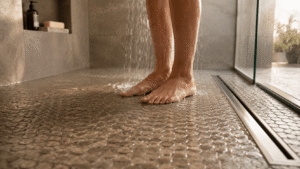
On walkin shower tile floors, small-format tiles outperform everything else because grout lines add traction. More grout means more grip. Straightforward math. The most popular options break down like this.
| Floor Tile Type | Slip Safety | Maintenance | Best For |
|---|---|---|---|
| Penny round porcelain | High (extra grout adds grip) | Low | Walk-in showers, compact baths |
| Hexagon mosaic | High | Moderate (more grout to seal) | Spa-style floors |
| Textured matte porcelain | Moderate-High | Low | Curbless or barrier-free showers |
| Natural pebble stone | High | High (regular sealing required) | Rustic or organic designs |
Want a safety benchmark? Look for a COF (coefficient of friction) rating above 0.42. That’s the ANSI A137.1 industry standard for wet tile. Most penny round and hexagon mosaics clear it with room to spare, while polished porcelain and glass tile usually fall short.
Herringbone, Chevron, and the Patterns Making a Comeback
Standard subway tile in a basic brick layout still works. Nobody’s arguing otherwise. But if you want a shower that stops guests mid-sentence, try a herringbone layout on the back wall of the shower. Same tile, different angle, completely different energy.
Chevron runs a similar play with sharper V-shapes cut into each piece. Geometric layouts using hexagonal or diamond-shaped tiles bring a contemporary edge, particularly in neutral palettes where the shape itself does the talking instead of the color. Want something bold without picking a bold color? This is how.
Here’s the trade-off most homeowners don’t expect. Patterned installations cost more in labor. Herringbone and chevron require precise 45-degree cuts and careful alignment row by row. A contractor budgeting six days for a standard tile shower might need eight or nine for herringbone walls. Material cost stays the same, but the labor line item climbs 15-25%. Worth it for a feature wall. Harder to justify across every wall.
Handmade Tile and Natural Textures Worth the Splurge
Ever run your hand across a wall of zellige tile? Each piece rests at a slightly different angle from the next, with color variation and tactile detail that factory-produced tile can’t touch. This hand-glazed Moroccan ceramic has moved from niche design blogs into mainstream remodels, and in a shower, those imperfections read as intentional and artisanal instead of sloppy.
Textured 3D wall tiles solve a different problem. Neutral-colored showers can look flat. Fluted designs, rippled profiles, and sculptural relief patterns catch light at different angles throughout the day, adding depth while keeping the palette neutral. Stick to one accent area, though. Tiling an entire shower in 3D feels overwhelming and creates cleaning headaches in the grooves.
Wood-look porcelain brings spa-like warmth and none of the moisture damage that comes with real wood near water. The newest versions feature wide plank formats with grain patterns realistic enough to fool most guests. And for homeowners who care about environmental impact, recycled-glass mosaics (some made with up to 80% post-consumer content) and tiles set with Greenguard-certified low-VOC adhesives cut your footprint, and the look doesn’t suffer for it. EcoStar’s approach to bathroom remodeling includes sourcing options like these for clients who want greener materials in their renovation.
Tile That Survives a Decade of Daily Showers
For showers, porcelain remains the strongest all-around pick. It absorbs less than 0.5% moisture and resists staining. Temperature swings don’t faze it, and you’ll find it in virtually every color and finish on the market. Ceramic costs less but soaks up more water, making it a weaker choice for shower floors and steam-heavy enclosures. Natural stone (marble, travertine, slate) ages with character but demands sealing every six to twelve months and stains faster from soap and shampoo residue. Glass mosaic cleans up fast and reflects light well, though it belongs in accents and niches rather than on full walls.
Grout deserves more thought than most homeowners give it. Epoxy grout runs roughly twice the price of cement-based, but it fights mildew, skips sealing, and holds its color for decades. In a shower, that premium pays for itself within two years of not scrubbing discolored lines on your hands and knees.
Ask your installer one question before buying tile. What does your shower’s substrate look like? Tile is only as durable as what sits underneath it. Cement backer board, a quality waterproofing membrane, and proper slope are the invisible foundation that keeps your visible tile ideas looking right for decades. A 2-year workmanship warranty, like the one EcoStar backs every project with, exists because that hidden prep work is where most shortcuts happen.
Strong shower tile ideas balance what you love looking at with what holds up to daily water, soap, and bare feet. Trends fade. A well-chosen tile paired with solid installation doesn’t.
FAQ
How much does a shower tile remodel cost?
Most projects land between $5,000 and $15,000 depending on shower size, tile material, and local labor rates. Basic retiling with porcelain sits toward the lower end. Adding niches, benches, or natural stone pushes the number higher. Material typically accounts for 30-40% of the total, with labor and prep covering the rest.
Can I mix different tile sizes in the same shower?
Yes, and it’s one of the smartest design moves you can make. A popular approach pairs large-format wall tile with small mosaic on the shower floor and a contrasting accent inside niches. Keep it to two or three formats, and tie the color palette together so the mix feels intentional, not scattered.
What’s the best tile for a small bathroom shower?
Light-colored, large-format tiles in matte or satin finishes make compact showers feel noticeably more spacious. Less grout means less visual clutter. Skip busy patterns across the whole shower and save them for one accent area or the niche instead.
How long does shower tile installation take?
A standard retile runs about four to six days from demolition through grouting. Adding a bench, multiple niches, or patterns like herringbone tacks on two to four more days. Allow 24-48 hours after grouting before stepping in, and another day for sealing if you’re using cement-based grout.
Do I need to seal shower tile after installation?
Porcelain and ceramic don’t need it. Natural stone does, typically within 24 hours of installation and again every 6-12 months depending on the type. All cement-based grout should be sealed regardless of what tile sits on top. Epoxy grout skips that step entirely, which is one big reason contractors keep recommending it for wet areas.